



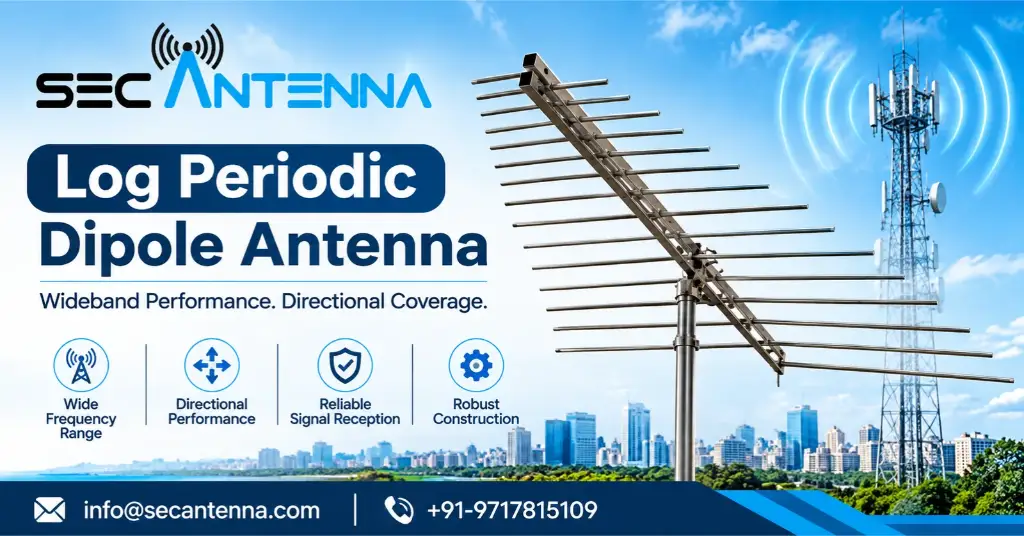
Log Periodic Dipole Antenna: Working, Uses & Benefits
Antenna performance plays an important role in wireless communication, broadcasting, testing, and signal monitoring. Different applications require antennas that can receive or transmit signals across specific frequency ranges while maintaining reliable performance. One popular solution for wide-frequency applications is the Log Periodic Dipole Antenna
This antenna is designed to operate across a broad range of frequencies without requiring a separate antenna for every frequency band. Its special arrangement of dipole elements helps provide consistent directional performance and reliable signal reception. It is commonly used in communication systems, RF testing, electromagnetic compatibility (EMC) testing, and other technical applications.
Understanding its working principle, features, and applications can help businesses and technical professionals select the right antenna for their requirements.
What Is a Log Periodic Dipole Antenna?
A Log Periodic Dipole Antenna is a directional broadband antenna made up of multiple dipole elements arranged in a specific pattern. These elements have different lengths and spacing, following a logarithmic relationship.
The longer elements generally operate at lower frequencies, while the shorter elements operate at higher frequencies. This arrangement allows the antenna to cover a wide frequency range while maintaining useful directional characteristics.
Unlike a standard dipole antenna, which is generally designed for a particular frequency range, a Log Periodic Dipole Antenna can support multiple frequencies within its specified operating bandwidth.
It is particularly useful when an application requires frequency flexibility, directional reception, and dependable RF performance.
How Does a Log Periodic Dipole Antenna Work?
The working principle is based on the different lengths and spacing of its dipole elements. When a radio signal reaches the antenna, the elements closest to the appropriate resonant length contribute most strongly to the radiation or reception process.
As the operating frequency changes, the active region shifts along the antenna array. Longer elements become more active at lower frequencies, while shorter elements become more active at higher frequencies.
This arrangement helps maintain performance across a broad frequency range. The antenna also uses a transmission-line structure to connect its elements and support the required electrical operation.
Its directional design helps focus signal reception or transmission towards a particular direction, depending on the installation and application.
Key Features of Log Periodic Dipole Antennas
A Log Periodic Dipole Antenna offers several useful features for professional RF and communication applications.
-
Wide Frequency Coverage: Supports multiple frequencies within its specified operating bandwidth.
-
Directional Performance: Helps focus signals in a preferred direction.
-
Consistent Operation: Provides useful performance across different frequencies.
-
Multiple Element Design: Uses dipoles of different lengths to cover a broader frequency range.
-
Professional RF Applications: Suitable for testing, monitoring, and communication environments.
-
Flexible Installation: Can be mounted according to the application’s positioning and coverage requirements.
Actual performance depends on the antenna design, frequency range, gain, polarisation, and installation conditions.
Applications of Log Periodic Dipole Antennas
These antennas are used in several industries where broadband directional signal handling is required.
| Application | Purpose |
|---|---|
| RF Testing | Used for evaluating radio frequency equipment and signals. |
| EMC Testing | Helps measure electromagnetic emissions during compliance testing. |
| Communication Systems | Supports broadband signal transmission and reception. |
| Spectrum Monitoring | Helps monitor signals across different frequency bands. |
| Research Laboratories | Used in antenna testing and RF experiments. |
| Wireless Signal Analysis | Supports directional signal measurement and investigation. |
A suitable antenna should always be selected according to the required frequency range, testing environment, and system specifications.
Log Periodic Dipole Antenna vs. Yagi Antenna
Both antennas are directional, but they have different design purposes. A conventional Yagi antenna is generally designed for a narrower frequency band, whereas a Log Periodic Dipole Antenna is developed to cover a wider frequency range.
| Comparison | Log Periodic Antenna | Yagi Antenna |
|---|---|---|
| Frequency coverage | Wide frequency range | Generally narrower range |
| Directionality | Directional | Directional |
| Element design | Multiple dipoles of different lengths | Reflector, driven element and directors |
| Main application | Broadband testing and monitoring | Band-specific communication |
The primary advantage of a Log Periodic Dipole Antenna over a standard Yagi is its wider frequency coverage. However, the right choice depends on the required gain, bandwidth, radiation pattern, and application.
How to Choose the Right Antenna?
Selecting the right antenna requires understanding the technical requirements of the communication or testing system. Before purchasing, consider the following factors:
-
Frequency Range: Check whether the antenna supports all required operating frequencies.
-
Gain: Select an appropriate gain level according to the required signal coverage.
-
Polarisation: Determine whether horizontal or vertical polarisation is needed.
-
Impedance: Check compatibility with the connected RF equipment and transmission cable.
-
VSWR: Review the voltage standing wave ratio to understand impedance matching.
-
Construction: Consider material quality, mounting hardware, and environmental conditions.
-
Connector Type: Ensure the connector matches the existing communication setup.
A Log Periodic Dipole Antenna should be selected according to its complete technical specifications rather than frequency range alone.
Why Choose SEC Antenna?
SEC Antenna is the trademark brand of Smart Electronics Communication, a Delhi-based manufacturer and supplier of antennas for wireless data and voice communication.
The company offers different antenna solutions for HF, VHF, UHF, TETRA, and microwave applications. Its SLP series includes multiple frequency configurations designed for professional communication, monitoring, scanning, and RF testing requirements.
The available Log Periodic Dipole Antenna models include:
| Model series | Available frequency options |
|---|---|
| SLP20 | 20–88 MHz to 20–3000 MHz |
| SLP30 | 30–88 MHz to 30–3000 MHz |
| SLP50 | 50–88 MHz to 50–3000 MHz |
| SLP88 | 88–512 MHz to 88–3000 MHz |
| SLP100 | 100–512 MHz to 100–3000 MHz |
The listed SLP models offer different configurations, with typical gain specifications of 7 dBi. Aluminium alloy construction and stainless-steel assembly hardware are among the product features described by the manufacturer. Custom connectors and finishes are also available on request.
A Log Periodic Dipole Antenna from SEC Antenna can be considered for applications requiring broadband directional transmission and reception. Customers should share their operating frequencies, installation requirements, and technical specifications before selecting a model.
Frequently Asked Questions (FAQs)
- What is a log periodic antenna?
A log periodic antenna is a broadband directional antenna made up of multiple elements of different lengths. It is designed to transmit and receive signals across a wide frequency range. - What is an LPDA antenna?
LPDA stands for Log Periodic Dipole Array. A Log Periodic Dipole Antenna uses multiple dipole elements arranged along a supporting boom to provide broadband directional performance. - What is the primary advantage of a log-periodic dipole array over a standard Yagi?
Its main advantage is wider frequency coverage. A standard Yagi generally operates within a narrower frequency range, while a Log Periodic Dipole Antenna can support multiple frequencies within its designed bandwidth. - Are dipole antennas directional?
A basic dipole antenna has a bidirectional broadside radiation pattern. However, an array of dipole elements, such as a log periodic design, provides directional transmission and reception. - What is a broadband antenna?
A broadband antenna is designed to operate across a wide range of frequencies without requiring frequent antenna changes. A Log Periodic Dipole Antenna is one example of this type of antenna.
Conclusion
Choosing the right antenna is important for achieving reliable communication, signal monitoring, and RF testing performance. A Log Periodic Dipole Antenna offers a useful combination of broadband frequency coverage and directional operation.
SEC Antenna provides different SLP series configurations to meet varying frequency and application requirements. Review the technical specifications and consult the manufacturer to identify a suitable antenna for your project.