



Log Periodic Dipole Antenna (LPDA)
Smart Electronics Communication manufacture and provide Log Periodic Dipole Antenna (LPDA) series working under variable frequencies.
| # | Model Series | Frequency | Bandwidth | Gain | Download | Enquiry |
| 1. | SLP20 | 20-88 MHz 20-136 MHz 20-512 MHz 20-1000 MHz 20-2000 MHz 20-3000 MHz | Full Band | 7 dBi |  |  |
| 2. | SLP30 | 30-88 MHz 30-136 MHz 30-512 MHz 30-1000 MHz 30-2000 MHz 30-3000 MHz | Full Band | 7 dBi | | |
| 3. | SLP50 | 50-88 MHz 50-136 MHz 50-512 MHz 50-1000 MHz 50-2000 MHz 50-3000 MHz | Full Band | 7 dBi | | |
| 4. | SLP88 | 88-512 MHz 88-1100 MHz 88-2000 MHz 88-3000 MHz | Full Band | 7 dBi | | |
| 5. | SLP100 | 100-512 MHz 100-1000 MHz 100-1500 MHz 100-2000 MHz 100-2500 MHz 100-3000 MHz | Full Band | 7 dBi | | |
| 6. | SLP80-2000 | 80-2000 MHz | Full Band | 7 dBi | | |
| 7. | SLP400-800 | 400-800 MHz | Full Band | 7 dBi | | |

SLP Model Series
We manufacture Log Periodic Dipole Antenna (LPDA) from 20 MHz upto 3000 MHz frequency band. Our antenna design reflects innovative modern antenna construction.
To prevent corrosion we use high quality aluminium alloys in Log Periodic Dipole Antenna fabrication.
The military and intelligence communities face a difficult challenge – the need to monitor communications over a very wide frequency range without being detected. Present electronic surveillance systems employ multiple antennas that are either large or noisy. Our antenna systems provide passive antennas in compact, versatile form factors that provide extreme wideband performance.
Our SLP series designed to provide wideband directional signals from VHF through to the UHF bands. The Log Periodic Dipole Antennas are available from 20-3000MHz. frequency range. This Log Periodic Dipole Antennas system is particularly suitable for broadband purpose. All the assembling hardware of log periodic dipole antenna is made of stainless steel.
SMART ELECTRONICS COMMUNICATION would be pleased to supply Log Periodic Dipole Antenna with, customized connector, any specified paint colour or custom finish.
Our antennas are designed to provide the best gain figures, for the requirements of the band and for the specific application where the antenna will be used.
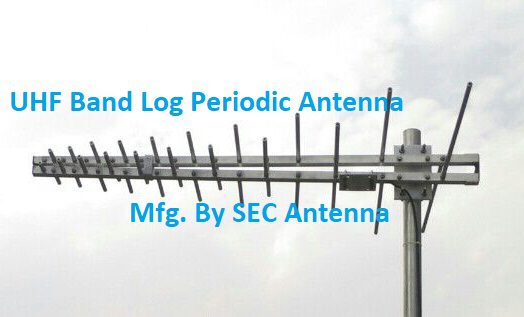


Log Periodic Dipole Antenna
Reliable antenna performance is essential for applications that require consistent signal transmission and reception across a broad frequency range. A Log Periodic Dipole Antenna is a widely used antenna solution designed to provide broadband performance while maintaining a practical and efficient structure. Its distinctive arrangement of dipole elements makes it suitable for applications where multiple frequencies need to be covered by a single antenna system.
At SEC Antenna, we focus on antenna solutions designed to meet the requirements of modern communication, testing, monitoring, and RF applications. A properly selected Log Periodic Dipole Antenna can provide dependable performance across its specified frequency range while offering directional characteristics that are useful for a variety of professional applications.
What Is a Log Periodic Dipole Antenna?
A Log Periodic Dipole Antenna consists of multiple dipole elements arranged along a supporting boom. The elements are generally different in length and are positioned according to a specific geometric relationship. This structure allows the antenna to operate over a relatively wide frequency range rather than being limited to a narrow operating band.
The antenna’s broadband characteristics make it useful when different frequencies must be monitored, measured, transmitted, or received without changing the complete antenna arrangement. Its directional nature can also help provide focused radiation and reception in the intended direction.
How Does a Log Periodic Dipole Antenna Work?
The operating principle of a Log Periodic Dipole Antenna is based on the interaction of its differently sized dipole elements. At a particular operating frequency, some elements become more active than others, creating an effective radiating and receiving region along the antenna structure.
As the operating frequency changes, the active region shifts to different elements. This enables the antenna to maintain useful electrical characteristics over a broad frequency range.
The actual performance of an antenna depends on factors such as frequency range, element dimensions, gain, impedance, polarization, installation conditions, and the surrounding environment. Selecting an antenna according to the intended application is therefore important for achieving reliable RF performance.
Key Features
A Log Periodic Dipole Antenna can offer several practical advantages for broadband RF applications:
Wide frequency coverage: Designed to operate across a broad specified frequency range.
Directional performance: Provides focused radiation and reception compared with many omnidirectional antenna configurations.
Broadband operation: Allows multiple frequencies to be handled using one antenna.
Consistent characteristics: Properly designed antennas can maintain useful performance throughout their operating range.
Practical construction: Multiple dipole elements are arranged on a supporting boom for a compact directional configuration.
Versatile applications: Suitable for RF testing, monitoring, communication, measurement, and other specialized requirements.
Applications of Log Periodic Dipole Antenna
The broadband nature of a Log Periodic Dipole Antenna makes it suitable for several professional and technical applications. Depending on its specifications, it can be used in RF and electromagnetic testing laboratories, communication systems, signal monitoring setups, antenna measurement environments, and field testing applications.
It can also be useful in situations where engineers need to work across multiple frequency bands without repeatedly changing antennas. For testing and measurement work, broadband directional characteristics can simplify equipment setup and help provide a practical solution for frequency-dependent measurements.
The exact application suitability depends on the antenna’s electrical specifications and the requirements of the complete RF system.
Why Choose the Right Antenna?
Choosing the right antenna involves more than simply selecting a model with a suitable frequency range. Engineers and system designers should consider parameters such as gain, impedance, VSWR, polarization, power handling, connector type, mechanical construction, and environmental conditions.
A Log Periodic Dipole Antenna should be selected according to the frequencies involved and the required radiation or reception characteristics. Installation height, orientation, cable losses, nearby structures, and other environmental factors can also influence real-world performance.
For specialized applications, reviewing the antenna’s technical datasheet and matching its specifications with the intended system is an important part of the selection process.
Log Periodic Dipole Antenna for Professional RF Requirements
Modern RF applications often require equipment that can work reliably across multiple frequencies. A Log Periodic Dipole Antenna provides a practical broadband approach for applications where frequency flexibility and directional performance are important.
Whether the requirement involves laboratory testing, field measurements, RF monitoring, communication experiments, or specialized antenna systems, the antenna should be evaluated according to the complete technical requirement rather than frequency range alone.
SEC Antenna can help customers identify an antenna configuration according to their application requirements, frequency range, installation conditions, and other technical parameters. Providing the right specifications at the beginning of the selection process can help ensure better compatibility with the overall RF setup.
Get the Right Antenna Solution from SEC Antenna
Selecting a suitable antenna is an important step in building an effective RF system. With the right specifications and application requirements, a broadband antenna can provide a practical solution for systems operating across multiple frequencies.
If you are looking for a Log Periodic Dipole Antenna for testing, measurement, monitoring, communication, or another RF application, share your required frequency range and technical specifications with SEC Antenna to identify a suitable solution.