


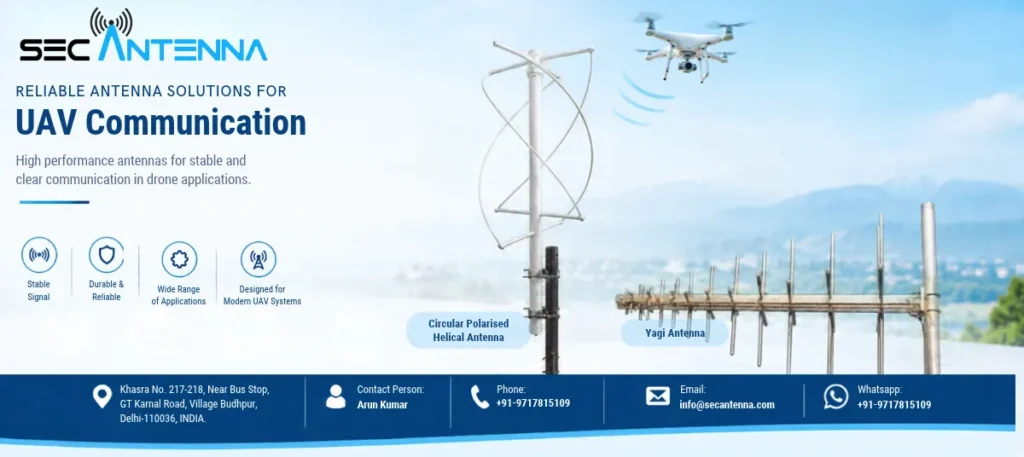
SEC Antenna for UAV Communication: A Simple Guide to Choosing the Right Antenna
Unmanned Aerial Vehicles (UAVs), commonly called drones, are used for agriculture, mapping, inspection, research, and security. They rely on communication links to exchange commands and data with ground stations. Choosing the right SEC Antenna for UAV Communication starts with understanding the drone’s purpose, radio system, and operating conditions. SEC Antenna for UAV Communication must match verified radio system requirements carefully.
SEC Antenna, from Smart Electronics Communication, provides antennas for wireless voice and data communication. UAV projects may have specific needs for frequency, size, mounting, and coverage. Check the manufacturer’s current specifications before selecting a model.
What Is UAV Communication?
UAV communication is the exchange of information between an aircraft and a ground station. Links may carry flight commands, telemetry, position information, images, video, or sensor data. Some aircraft use separate links for different tasks.
An antenna converts electrical radio-frequency energy into radio waves for transmission and received waves into electrical signals. A suitable SEC Antenna for UAV Communication must match the radio equipment and its intended task. SEC Antenna for UAV Communication should support the required frequency band reliably.
Why Does an Antenna Matter?
A UAV changes distance, direction, and height during flight, which can affect its signal. Buildings, trees, terrain, and radio interference may also influence the link.
A suitable antenna supports signal transmission and reception, but cannot guarantee a reliable connection alone. Transmitter power, receiver sensitivity, cable losses, placement, interference, and regulations also matter. For SEC Antenna for UAV Communication, assess the complete radio link. SEC Antenna for UAV Communication depends on careful system-level technical selection.
Common Antenna Types
Different antenna designs suit different needs. Choice depends on frequency, coverage, movement, space, and connected equipment.
- 1. Omnidirectional Antennas
An omnidirectional antenna provides broad horizontal coverage. It can suit systems that need to communicate in several directions without pointing continuously at a target. Coverage depends on design and installation. - 2. Directional Antennas
Directional antennas focus more energy in one direction. They may suit a ground station that can point toward the aircraft. Higher gain may improve performance in that direction but narrow the coverage area.
SEC Antenna offers different designs for communication applications. For SEC Antenna for UAV Communication, confirm the intended use and published data. Not every general-purpose radio antenna is suitable for aircraft installation. SEC Antenna for UAV Communication requires secure mounting and suitable cable routing.
Features to Check Before Buying
Frequency range: The antenna must support the frequency used by the transmitter and receiver. A mismatch can reduce performance.
Gain and radiation pattern: Gain describes how energy is distributed in different directions. The radiation pattern shows where the antenna transmits or receives most effectively. Higher gain is not always better if wide coverage is needed.
Polarization: The transmitting and receiving antennas should have compatible polarization. A mismatch can reduce the received signal.
Size and weight: An antenna fitted to an aircraft must suit its available space and payload limits. The mounting position should not interfere with flight controls or other equipment.
Connectors and cables: Check connector type, cable length, and cable quality. Poor connections or unnecessary cable losses can weaken the signal.
Environmental protection: Consider expected vibration, moisture, dust, temperature, and outdoor exposure. The selected product should suit the operating environment.
Regulatory requirements: Confirm that the radio equipment and frequency use comply with applicable local rules. Do not rely on antenna selection alone to establish compliance.
These checks help buyers compare options and discuss SEC Antenna for UAV Communication with a supplier. SEC Antenna for UAV Communication should be checked against current product datasheets. Clear requirements make product comparisons easier.
How to Choose the Right Antenna
Identify the UAV’s purpose first. Crop monitoring, inspection, surveying, and research may require different links. List the data to be sent, expected distance, and whether the antenna will be on the aircraft or ground station.
Confirm the radio’s frequency, power, connector, and polarization. Check installation space, weight limits, obstacles, and flight conditions. Compare specifications with these needs and ask the supplier for guidance if needed.
For SEC Antenna for UAV Communication, share the frequency, purpose, mounting location, size limits, connector, environment, and test standards with the supplier. SEC Antenna for UAV Communication must fit the aircraft’s available space limits. Request a datasheet and verify performance claims before ordering.
Testing and Installation
Follow the manufacturer’s instructions for mounting, cable routing, grounding where applicable, and connector handling. Consider interference and how the UAV body, batteries, and motors may affect signals.
Test signal strength, data quality, coverage, and stability under controlled conditions before use. Follow safety procedures and regulations. If performance is poor, inspect connectors, cables, orientation, interference, and antenna placement.
Assess SEC Antenna for UAV Communication as part of the whole radio system; results can vary with aircraft and equipment. SEC Antenna for UAV Communication needs testing under expected operating flight conditions.
Where UAV Communication Is Used
UAVs support crop observation, surveying, infrastructure inspection, research, and authorised monitoring. They collect field images, mapping data, inspection views, and research information.
Each task has different data, range, and safety needs. SEC Antenna for UAV Communication should support the intended control or data link. Select for the actual use, considering the aircraft, radio, ground station, environment, and rules.
Why Consider SEC Antenna?
SEC Antenna provides antenna solutions for wireless communication. Review its current catalogue and datasheets, and ask whether a model meets the project’s technical needs.
Ask about frequency, gain, radiation pattern, dimensions, weight, connector, environmental rating, mounting, and operating conditions. SEC Antenna for UAV Communication works best when matched to connected equipment. Clear answers reduce the risk of choosing an unsuitable product.
For best results, SEC Antenna for UAV Communication should be selected only after checking the radio’s frequency, mounting limits, polarization, connector compatibility, and expected conditions with the manufacturer or system integrator in advance.
Conclusion
Antenna selection depends on frequency, coverage, polarization, gain, size, weight, installation, and environment. Test the complete system because performance depends on more than the antenna.
If evaluating SEC Antenna for UAV Communication, document your radio specifications and operating needs, then compare them with verified product data. Visit https://secantenna.com/ to explore the range and make an enquiry.